

Handling big data with Purge-it
Discover how Purge-it handles large volumes of JD Edwards data in this blog article
Read more >
The year in review
Looking back on 2025 milestones and ahead to more JD Edwards in 2026!
Read more >
How do you manage JD Edwards data without JD Edwards?
As your JD Edwards system is retired you may start to lose JD Edwards skills and knowledge. Find out how to address this challenge.
Read more >
Data Management for your JD Edwards Data
Is your organization thinking about the subject of data retention for your JD Edwards system? In this article we explore key discussion points around developing a meaningful Data Retention Policy.
Read more >
What is Data Archiving?
Find out how Data Archiving and Data Purging fit into Data Lifecycle Management
Read more >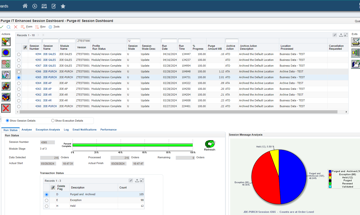
How to delete JD Edwards data that has passed its retention date and not just archive it
If your data archive is growing and you need to take action, check out how functionality in Purge-it Version 5.2 allows the possibility to completely remove old data from the archive
Read more >
How to measure the success of Data Archiving (Part 3)
In the final part of this 3 part series of blog articles 'measuring the success of data archiving', we look at two more customer examples
Read more >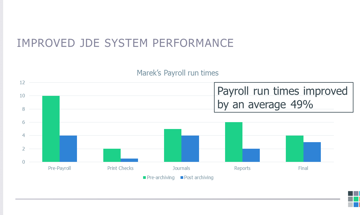
How to measure the success of Data Archiving (Part 2)
In part 2 of 'measuring the success of data archiving', we look at real customer examples
Read more >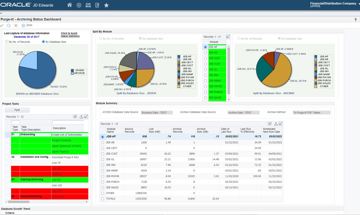
How to measure the success of Data Archiving (Part 1)
Can you measure the impact of data archiving? How do you demonstrate ROI? We address these questions and others in this JD Edwards article
Read more >
What is Oracle Validated Integration (OVI)?
Find out how Klik IT achieving Oracle Validated Integration with JD Edwards EnterpriseOne Expertise for its integration of Purge-it can help you and your organization
Read more >
Purge-it Version 5.2 FAQs
Explore some of the most frequently asked questions relating to the latest release of the JD Edwards data archiving solution, Purge-it
Read more >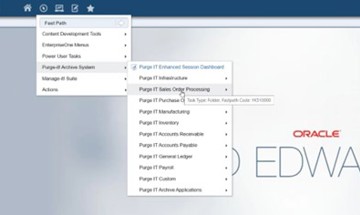
Is Purge-it easy to use for E1 data archiving?
Purge-it customers tell us one of the key drivers for choosing the data archiving solution is its usability. In this blog post we look at the main factors that make Purge-it easy to use.
Read more >
What is Purge-it?
Find out all about Purge-it. How it works, who it's for and what it offers JD Edwards users
Read more >
Get a JD Edwards data healthcheck
In this blog post we look at how the JD Edwards data archiving solution Purge-it! gives your JD Edwards system a health check.
Read more >
30 features of Data Archiving with Purge-it
Discover the top 30 features of data archiving with Purge-it that make it a truly easy product to implement.
Read more >
What is JD Edwards Archiving as a Service?
You're no doubt familiar with the as a Service model. Discover the business benefits of opting for Archiving as a Service for your JD Edwards E1 data archiving needs in this blog post.
Read more >
8 reasons to automate your JD Edwards archiving
Checkout this second blog post on archive automation. We zoom in on the 8 top reasons to automate your JD Edwards archiving.
Read more >
What is archive automation for JD Edwards?
Find out how human intervention in the routine task of archiving JD Edwards data can be greatly reduced. We’re talking about archive automation. It can help achieve remarkable ongoing efficiencies.
Read more >
What is meant by an integrated JD Edwards archiving solution?
What's the difference between an external and an internal archiving product when it comes to JD Edwards archiving? Read our short blog post as we summarize the differences.
Read more >
Why is JD Edwards running slow?
Deteriorating system performance negatively impacts many job functions across an organization. Find out why you system is slow. Discover how to speed up your JD Edwards system and enhance the user experience.
Read more >
Find out which version of Purge-it! your organization is running
Make sure your organization is maximizing its use of the archiving solution Purge-it! Find out which software version you have. Discover the latest product enhancements and new Purge-it! features and functionality.
Read more >
How Klik IT started 25 years ago...and what's next?
As Klik IT celebrates 25 years in business in 2023, we took some time out to chat to CEO, Terry Clarke.
Read more >
Find a JD Edwards archiving solution that works for your business. Ask these 5 questions.
Is your organization looking for a 3rd party archiving solution?
Checkout 5 key questions to ask when evaluating JD Edwards archiving tools and solutions.
Read more >
Data Retention & Security
Data Retention and Security is a hot topic and a vast subject.
In this Blog post we look at Data Retention and Security from the perspective of organizations running JD Edwards. We cover the key considerations as we see them and provide links to industry articles and information for a broader view of the subject.
Read more >Handling big data with Purge-it

We’re sometimes asked by JD Edwards organizations whether Purge-it can handle archiving (and if required purging) really large volumes of JD Edwards data. In this article we address how to run a big data Purge-it project based on many years of successful company implementation experiences.
When running an archive project where the database size is extremely large, it’s important that the correct approach is agreed and followed from the outset. This is especially advisable in the General and Item Ledgers of organizations with large data volumes.
We advise an approach that targets the following points:
- Get the archive process running in Production as quickly as possible by taking a module by module implementation approach
- Reduce testing to levels that can validate and signoff the test results without necessarily running over 100’s of millions of transactions
- Use Purge-it archive automation to automate the process over a period of time to achieve the required results. This has the added benefit of minimising user involvement and only requiring occasional monitoring via the Purge-it environment and session dashboards.
Two key points to keep in mind:
- Set realistic expectations of the time it’ll take to complete the data archiving project
- Don’t over manage the project, because in practice, data archiving with Purge-it is a fairly simple process.
What does a Purge-it project consist of?
Phase 1 of a typical data archiving project
Get set up and started
- This starts with a kick off meeting to discuss the process and ensure everyone is aligned in the process and the project objectives
- Refresh the Test environment if necessary
- Install and configure the Purge-it software (performed by Klik IT inhouse JD Edwards data archiving experts)
- Get your team trained (performed by Klik IT’s inhouse JD Edwards trainer)
Phase 2 of a typical data archiving project
- Running the project
- Agree the archiving rules for your project. For example, data retention dates, validations to use etc.
- Review custom tables to see which need to be archived (and purged if required)
- Look to automate the archive process
- Address company specific documentation requirements
(each organization knows its own internal project processes)
How to set up your data archiving project
for a successful outcome
Questions and Answers
Question: What should we be thinking about to get ready for our data archive project?
Answer: The dates used for archiving JD Edwards data are key. One area to start thinking about and discussing is data retention dates across your business. It’s entirely up to each organization how many years of data is retained. Remember that archive data is easily accessible via Purge-it apps.
Question: Is it necessary to run everything in test before moving to production?
Answer: How the archive project is ordered, approached and executed is critical to the success of the project itself. It would be easy to think about approaching the different tasks in a sequential order and running everything in test before moving to production. Experience has shown that this is often the wrong approach for organizations with large amounts of data.
Question: What action should we take if we see a lot of exceptions in our test results due to poor data quality?
Answer: It’s important to remember that if you see exceptions that are due to poor data quality you don’t have to fix these. This data exists in your system now and it might do after your data archiving project, there is no difference. It doesn’t have to be the job of this project to clean the data.
It’s possible to take this opportunity to clean the data but it might have a disproportionate effect on the time to run the data archiving project.
Remember!
- Look for quick wins
- Look at the archive efficiency and remember the 80/20 rule.
If you get rid of 80% of the data for 20% of the effort then this is a good place to be, so move on. - It’s about running jobs. Be pragmatic in your approach. Aim to not over analyse or over manage the data archiving project.
Running the project with large data
- When testing, use a reduced data set in order to get this phase of the project completed quickly.
Example:
If you decide to archive 10 years of JD Edwards historic data, then consider running the tests over a few months of this data. Let’s say 3 months of the data or if you prefer, as much as 12 months data, but do not run over the full 10 years.
It’s perfectly possible to check and verify the results adequately on a smaller dataset. - Automate your data archiving. Set it and forget it!
For the General Ledger and Inventory modules, due to the number of indexes on the tables and the need to summarise them, the initial runs of these jobs can take some time. When an organization has a large amount of JD Edwards data (500M plus records) then we suggest setting up daily jobs on the scheduler and leaving them to run. Each of these jobs will archive one days’ data for a specific year in the archive.
Consider this scenario:
If you have 10 jobs running daily, individually on a daily basis they may run for a few hours, but over the course of a year, 10 years data will be removed from the system. These jobs will be background tasks requiring minimal monitoring.
There will be no system downtime. System maintenance and processes are unaffected.
This approach has been incredibly successful with a number of our clients including those with extremely big data.
Running a Purge-it JD Edwards data archiving project isn’t a ‘one size fits all’ approach. Purge-it is a flexible data management solution that allows for variations in resource availability, the size of the data set and differing internal company procedures.
News Snapshot...
Q&A
How to set up your data archiving project for a successful outcome
Q: What should we be thinking about to get ready for our data archive project?
A: The dates used for archiving JD Edwards data are key. One area to start thinking about and discussing is data retention dates across your business. It’s entirely up to each organization how many years of data is retained. Remember that archive data is easily accessible via Purge-it apps.
Q: Is it necessary to run everything in test before moving to production?
A: How the archive project is ordered, approached and executed is critical to the success of the project itself. It would be easy to think about approaching the different tasks in a sequential order and running everything in test before moving to production. Experience has shown that this is often the wrong approach for organizations with large amounts of data.
Q: What action should we take if we see a lot of exceptions in our test results due to poor data quality?
A: It’s important to remember that if you see exceptions that are due to poor data quality you don’t have to fix these. This data exists in your system now and it might do after your data archiving project, there is no difference. It doesn’t have to be the job of this project to clean the data.
It’s possible to take this opportunity to clean the data but it might have a disproportionate effect on the time to run the data archiving project.
Remember!
- Look for quick wins
- Look at the archive efficiency and remember the 80/20 rule. If you get rid of 80% of the data for 20% of the effort then this is a good place to be, so move on.
- It’s about running jobs. Be pragmatic in your approach. Aim to not over analyse or over manage the data archiving project.