Introducing Purge-it Release 5.3
With the latest release of Purge-it we've focused on giving JD Edwards users more insight, more control and better archiving results
Read more >
Does Data Archiving have a role to play in JDE Data Governance?
We're looking at how managing data through its lifecycle can help support effective JD Edwards data governance.
Read more >
JD Edwards E1 Upgrade SIG presentation
Catch-up with Richard Wilde's June presentation to the E1 Upgrade SIG: Data Archiving as an Upgrade Enabler
Read more >
Handling big data with Purge-it
Discover how Purge-it handles large volumes of JD Edwards data in this blog article
Read more >
The year in review
Looking back on 2025 milestones and ahead to more JD Edwards in 2026!
Read more >
How do you manage JD Edwards data without JD Edwards?
As your JD Edwards system is retired you may start to lose JD Edwards skills and knowledge. Find out how to address this challenge.
Read more >
Data Management for your JD Edwards Data
Is your organization thinking about the subject of data retention for your JD Edwards system? In this article we explore key discussion points around developing a meaningful Data Retention Policy.
Read more >
What is Data Archiving?
Find out how Data Archiving and Data Purging fit into Data Lifecycle Management
Read more >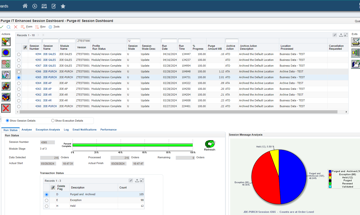
How to delete JD Edwards data that has passed its retention date and not just archive it
If your data archive is growing and you need to take action, check out how functionality in Purge-it Version 5.2 allows the possibility to completely remove old data from the archive
Read more >
How to measure the success of Data Archiving (Part 3)
In the final part of this 3 part series of blog articles 'measuring the success of data archiving', we look at two more customer examples
Read more >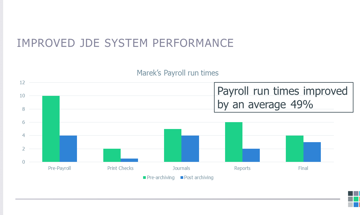
How to measure the success of Data Archiving (Part 2)
In part 2 of 'measuring the success of data archiving', we look at real customer examples
Read more >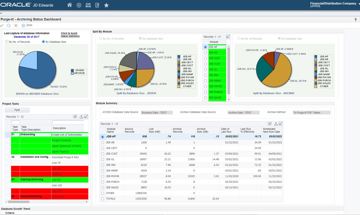
How to measure the success of Data Archiving (Part 1)
Can you measure the impact of data archiving? How do you demonstrate ROI? We address these questions and others in this JD Edwards article
Read more >
What is Oracle Validated Integration (OVI)?
Find out how Klik IT achieving Oracle Validated Integration with JD Edwards EnterpriseOne Expertise for its integration of Purge-it can help you and your organization
Read more >
Purge-it Version 5.2 FAQs
Explore some of the most frequently asked questions relating to the latest release of the JD Edwards data archiving solution, Purge-it
Read more >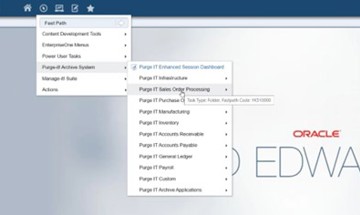
Is Purge-it easy to use for E1 data archiving?
Purge-it customers tell us one of the key drivers for choosing the data archiving solution is its usability. In this blog post we look at the main factors that make Purge-it easy to use.
Read more >
What is Purge-it?
Find out all about Purge-it. How it works, who it's for and what it offers JD Edwards users
Read more >
Get a JD Edwards data healthcheck
In this blog post we look at how the JD Edwards data archiving solution Purge-it! gives your JD Edwards system a health check.
Read more >
30 features of Data Archiving with Purge-it
Discover the top 30 features of data archiving with Purge-it that make it a truly easy product to implement.
Read more >
What is JD Edwards Archiving as a Service?
You're no doubt familiar with the as a Service model. Discover the business benefits of opting for Archiving as a Service for your JD Edwards E1 data archiving needs in this blog post.
Read more >
8 reasons to automate your JD Edwards archiving
Checkout this second blog post on archive automation. We zoom in on the 8 top reasons to automate your JD Edwards archiving.
Read more >
What is archive automation for JD Edwards?
Find out how human intervention in the routine task of archiving JD Edwards data can be greatly reduced. We’re talking about archive automation. It can help achieve remarkable ongoing efficiencies.
Read more >
What is meant by an integrated JD Edwards archiving solution?
What's the difference between an external and an internal archiving product when it comes to JD Edwards archiving? Read our short blog post as we summarize the differences.
Read more >
Why is JD Edwards running slow?
Deteriorating system performance negatively impacts many job functions across an organization. Find out why you system is slow. Discover how to speed up your JD Edwards system and enhance the user experience.
Read more >
Find out which version of Purge-it your organization is running
Make sure your organization is maximizing its use of the archiving solution Purge-it Find out which software version you have. Discover the latest product enhancements and new Purge-it features and functionality.
Read more >
How Klik IT started 25 years ago...and what's next?
As Klik IT celebrates 25 years in business in 2023, we took some time out to chat to CEO, Terry Clarke.
Read more >
Find a JD Edwards archiving solution that works for your business. Ask these 5 questions.
Is your organization looking for a 3rd party archiving solution?
Checkout 5 key questions to ask when evaluating JD Edwards archiving tools and solutions.
Read more >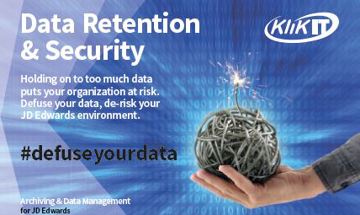
Data Retention & Security
Data Retention and Security is a hot topic and a vast subject.
In this Blog post we look at Data Retention and Security from the perspective of organizations running JD Edwards. We cover the key considerations as we see them and provide links to industry articles and information for a broader view of the subject.
Read more >Does Data Archiving have a role to play in JDE Data Governance?

Does Data Archiving have a role to play in JD Edwards Data Governance?
In this article, we focus on how managing data through its lifecycle, which includes JD Edwards data archiving and data purging, can help support effective JD Edwards data governance.
Data governance has become a priority for many organizations running JD Edwards. Driven by increasing regulatory requirements and growing volumes of data, businesses are under pressure to demonstrate their data is being managed responsibly.
Organizations have tended to keep everything, almost hoarding EnterpriseOne data, and in some cases World data, just in case. However, whilst retaining data may feel like the safest option, it's rarely the most effective. Retaining data indefinitely can introduce risk and increase complexity.
Effective governance isn't about keeping all data forever. It's about knowing what data you have, why you have it and how it should be managed through its lifecycle.
What does good data governance look like for organizations running JD Edwards?
When discussing governance, it's easy for businesses to focus on differing regional and industry policies, regulations and data compliance requirements. These are all important, but they only represent part of the picture.
We’ve listed 7 key questions to consider in relation to JD Edwards data retention and data governance:
- What data exists within the organization?
- Why is that data being retained?
- How long should it be retained?
- When should it be archived?
- Does any of it need to be completely removed (purged)?
- Who needs access to it?
- Can it be retrieved if needed?
Without answers to these seven questions, organizations can find themselves retaining large volumes of historical data with little understanding of its business value or the risk it could be posing.
The challenge facing JD Edwards users
Many JD Edwards systems have been supporting business operations for years and in some cases for a number of decades. Over time, transaction histories grow and the size of the JDE database grows. In reality, many records remain in the database long after their operational value has passed. It’s true that some data will need to be retained for future audit requirements or for legal or regulatory purposes. Despite this, not all data needs to remain in the live production environment.
The two competing requirements:
i. Maintaining access to historical EnterpriseOne data.
ii. Managing the data efficiently and responsibly.
This is where JD Edwards data governance and data archiving become more closely linked.
Is data archiving a governance tool?
Archiving JD Edwards data is often viewed solely as an exercise in addressing JDE database growth. In reality, the value of data archiving and data purging extends much further.
Data archiving can help organizations establish clear and repeatable processes for managing JD Edwards data through its lifecycle. Rather than allowing data to accumulate indefinitely, organizations can define:
- What data should remain operational and what should be archived
- When archiving should happen and whether some data should be purged
- How archived data will be accessed
- How data retention requirements will be met
Each of these points helps to ensure EnterpriseOne data is being managed consistently across the business.
Can I keep access to archive data without keeping everything live?
Yes! We know one of the most common concerns surrounding JD Edwards data archiving is the fear of losing access to historical data.
Users can maintain access to historical customer, supplier, financial and operational data. Auditors may require data to be accessible from previous years. Regulatory requirements may demand extended retention periods depending on regional location and industry sector.
Archiving doesn’t need to remove access to data. Archive data can be accessed.
By separating operational data from historical transaction data, while maintaining visibility of archived records, organizations can satisfy governance requirements without carrying the burden of keeping everything in the production environment.
Are you prepared for future data governance requirements?
Governance requirements continue to evolve and change. New regulations and differing data retention obligations mean organizations need a flexible approach to managing EnterpriseOne data and their growing data volumes.
Businesses that understand their JD Edwards data and manage it through its lifecycle are often better positioned to respond to future data compliance and governance challenges.
As we mentioned earlier in the blog, good governance doesn’t mean you have to keep all your JD Edwards data forever. The aim is to keep the right JDE data for your organization and your industry sector, in the right place, according to your defined data retention rules, for the amount of time that works for your business requirements.
Not sure what data you're holding in JD Edwards?
⇒ Gain visibility of the volume, distribution and age of your EnterpriseOne data and identify potential archiving opportunities with a complimentary Data Analysis.
⇒ Request your JD Edwards Data Analysis today.
News Snapshot...
Is data archiving a governance tool?
Archiving JD Edwards data is often viewed solely as an exercise in addressing JDE database growth.
In reality, the value of data archiving and data purging extends much further.
Data archiving can help organizations establish clear and repeatable processes for managing JD Edwards data through its lifecycle.
Rather than allowing data to accumulate indefinitely, organizations can define:
- What data should remain operational and what should be archived
- When archiving should happen and whether some data should be purged
- How archived data will be accessed
- How data retention requirements will be met
Each of these points helps to ensure EnterpriseOne data is being managed consistently across the business.
Does your organization have a Data Retention Policy for your JD Edwards ERP?